Wednesday, April 8, 2015

How to Install a Rapids Home Refrigerator Kegerator Conversion Kit

www.rapidswholesale.com
Hey folks, I thought I would take a moment here to walk you through the process of converting a standard home refrigerator into your very own kegerator unit using Rapids kegerator conversion kits. It’s really quite simple, and in no time you’ll be enjoying your own draft beer from your very own DIY kegerator. I'll walk you through my last conversion, but first . . .

Why People Convert Fridges to Kegerators

There are a lot of reasons why people buy these kegerator conversion kits. They make for a really inexpensive solution for a home brewer to share their passion with friends. A lot of people buy these for use in their garages and man caves; serving up domestic commercially brewed beers to their pals. Many are purchased by fraternities and other social groups with thirsty folk, and it’s not uncommon for a bar our civic organization to install them as an inexpensive satellite beer dispenser, away from their main bar – maybe on a patio or down by the dock. Whatever the reason, I’ve found these Rapids kits are the most complete and are really simple to install.

Why Use a Rapids Conversion Kit?

Harry Ribble of Rapids Wholesale
Harry Ribble
Rapids knows beer. Especially beer dispensing!

Rapids founder, Harry Ribble, was a former Pabst Brewery employee who actually designed and patented the first direct draw beer dispenser the world has ever seen. He left Pabst and started Rapids Wholesale way back in 1936. Rapids has built on that tradition of consistently ensuring full pint glasses for thirsty folks ever since. They work with brewers, distributors, bar owners, parts machinists and manufacturers nationwide. And now they’ve brought that expertise home to you.

Beer Dispenser Tapping Kits for Commercial Beer Dispensers

Commercial Kegerator at Rapids Wholesale
Commercial Kegerator
Rapids offers seven different kit configurations to help you hook up whatever kind of beer dispenser you have. If you have purchased a commercial beer dispenser and only require the addition of a CO2 system, the Rapids Beer Dispenser CO2 Kit is likely all you need. It has the CO2 cylinder, dual gauge regulator, and air line to attach to your commercial beer dispenser. Rapids Deluxe Tapping Kit includes a sankey keg coupler and a handy beer line cleaning kit.


Kegerator Conversion Kit Options

If you are starting from scratch with a home refrigerator, the Deluxe Kegerator Conversion Kits are the perfect “everything you need - one stop shop” solution. They come with either a dual gauge or single gauge regulator. For the little extra loot, I strongly suggest springing for the dual gauge regulator. The extra gauge lets you know when you are running out of gas. Invaluable information if you a planning a weekend get together with friends.

The Deluxe kits also include a beer line cleaning kit with all the tools you need to keep your keg fridge serving the best tasting beer with perfect pours. A clean beer dispensing system is essential to accurate taste and aroma as well as pouring dynamics. Dirty lines and faucets can cause huge heads and skunky flavors. Deluxe kits also have drip trays to save your floor when you over pour.

Super Kegerator Kits do not include the cleaning kit and drip tray. They come with a single gauge regulator and all the essential components needed to dispense along with a faucet brush and spanner wrench. The other configurations assume you already have a CO2 supply or faucet plumbing in place.

Rapids Kegerator Kit Installation Procedure

Kegerator Installation How-To Video


In this video, I'll show you the quick install of my latest conversion. Below the video you will find more information and tips and tricks for your installation.


Selecting the Donor Fridge

Fridgeman Concept
Now for the fun part – installing the components. The very first thing you need to do is track down a donor refrigerator. Make sure you get one big enough to hold the keg type you wish to use. For Cornelius kegs (corny kegs) and Sixth Barrel kegs (log kegs), you can often get away with using a taller dorm sized fridge.  They are only about 9 inches in diameter leaving room inside for both the keg and your CO2 tank. Keep in mind though, these kegs are still nearly 2 foot tall, and you’ll need to fit a coupler on top of that, so choose wisely.

For Quarter Barrel kegs (pony kegs) and traditional Full Sized kegs (actually called half barrel), you’ll likely need to opt for a full size refrigerator. You should budget for a 17 inch diameter for the keg and add the diameter of your CO2 cylinder (about 5-1/2 inches for a 5 lb. tank). Mounting the cylinder outside of the fridge and running a line through another hole in the side is an option, but obviously a little more engineering would be required.

Stripping Down the Refrigerator

Rapids Keg Fridge Build
Stripping Down
Okay, now that you have your donor fridge in place, you need to make room inside to fit the keg. This means you’ll have to pull out all drawers and shelving to make space. In some cases you will be able to throw a shelf or two back in the fridge on the top after the install. But for starters you’ll want to remove everything to give you working space.

Some refrigerators are not flat on the bottom. If there is a drawer unit, be sure to pull it out and look behind it to see if the floor extends all the way to the back wall. If not, you may have to devise some sort of platform to fit the keg on. I used a milk crate and plywood to get over the hump in mine. Putting a sheet of plywood down on the bottom is recommended even if you do have a flat bottom. It will prevent the floor from getting too banged up from moving the kegs in and out. Who knows, maybe one day you’ll want to sell this bad boy . . . might as well keep it pretty!

UNPLUG the refrigerator! Soon you will be drilling into it. Save yourself from potential electrical shock and an embarrassing trip to the ER . . . or worse. Don’t be an idiot, UNPLUG THE FRIDGE!

Drill Baby, Drill!


Rapids Keg Fridge Build
Drilling a 1 inch Hole in the Door for the Beer Shank

The beer has to come out of the fridge. It does our bellies no good staying locked up inside. To get the beer outside, we gotta get through the door or a sidewall. I’ve built conversions each way, but I prefer going through the door. There is a risk of drilling through a coolant line if you drill through the side of the fridge. So if you DO decide to go through a sidewall, do yourself a favor and first drill a tiny hole through the outer aluminum skin only. Stick a toothpick or something in there to make sure the path is clear to drill all the way through to the interior panel with no obstructions.

Door mounting is a lot easier but can have its own set of smaller challenges. Some refrigerators may have in-door ice and water dispensers. Obviously, you’ll want to avoid drilling through those and any wiring that may support them. Locate a wiring diagram or schematics for your model and inspect it carefully before deciding where to place your faucet. Most fridges donated for this purpose are usually not that high tech.

Interior door shelving is another consideration. You will need to locate a faucet position that will not be obstructed on the inside by a door shelf. Find a location that provides the least distance to drill through. In my latest conversion, I did have to remove the door shelving entirely to provide enough room for a full size keg and cylinder within. It was a pretty narrow unit that wasn’t very deep. The one piece plastic molded shelving unit I removed also secured the door gasket, so I chose to attach the gasket with the sheet metal screws from the shelving and sealed it with a bead of silicone. Plastic trim pieces around the gasket in place of the removed shelving unit may be a better idea. Less mess anyway.

48 inches up from the floor is supposedly the ideal comfortable pouring height. That’s the target, but obviously your fridge design may cause you to stray a bit from that height. Another thing to keep in mind when you select your faucet position would be the faucet tap handle height.

The faucet knob that comes supplied with the Rapids kits is going to stand about three inches up from the faucet. Add another inch for the lever bonnet and collar on the faucet, and 1/2 inch for the radius of the hole you need to drill for the shank. That means if you use the small supplied tap handle it will stick up about 4-1/2 inches from your mark. Now look at your donor fridge. Does it have a freezer unit on top? See where this measurement becomes important? And did you have big plans to get an awesome ornate hand sculptedfaucet tap handle that sticks up 10 inches?

If you place your faucet too high, it may prevent you from being able to open the freezer door without running into the faucet tap handle. No frosty mugs for you! This is one of the reasons why elected to use a “side by side” donor fridge on my last conversion. With the freezer unit on the side of the fridge, I was able to place the faucet pretty much wherever I wanted. Another advantage to the side by side is more room top to bottom inside the fridge. I can place more shelving on top and I’m even considering stacking two pony’s with a keg stacker spacer for tapping and running another faucet!

Okay, now that you’ve settled on your faucet location that’s as close to 48 inches from the floor as it can be, but still will allow you to open the top freezer without a mess, you are going to want to mark it off and drill baby, drill. I’ve found that a 1inch hole saw with pilot bit works best to drill the hole (pictured above). Keep the pilot bit from sliding around by punching a divot in the door it can start on with a hammer and an awl.

Installing the Beer Faucet Shank


Shank Diagram

Once you have created the hole and cleaned away any debris from the drilling process, it’s time to install the beer faucet shank. Slide the shank through the hole with the black plastic flange part on the outside of the door. On the inside of the door, you will attach the forged brass lock nut. If you have removed the inner door shelving panel on the door, you may want to consider putting up some sort of solid backing between the door insulation and the brass lock nut. If you try to tighten the lock nut to nothing but foam insulation, the faucet will likely just flop around on the door; a small piece of plywood or plastic works well for this purpose. Think of it as a really big washer. If you feel the need to further seal the door, you could run a bead of silicone around the shank in the door.

Installing the Beer Faucet to the Beer Shank

Attaching Faucet to Shank
With the beer shank secured in the door, the next step is to attach the beer faucet to the shank. There is a coupling nut on the shank that you will spin counter-clockwise with the faucet pressed up against it. Use a spanner wrench to snug it up, but be sure not to over tighten it. Periodically you will be removing the faucet to clean it. If you He-Man the thing on, you could be creating a future inconvenience. There are o-rings in the faucet to seal it from leaking.

On the top of the faucet you will attach the faucet knob or tap handle. If you get one of those fancy sculpted tap handles or maybe a branded tap handle, there is a neat little trick to make sure you have it front facing. What you do is spin the thing all the way down, then back it off until it is positioned the way you like it. Now if you spin the lever collar back to meet it, you can secure it in place facing forward.
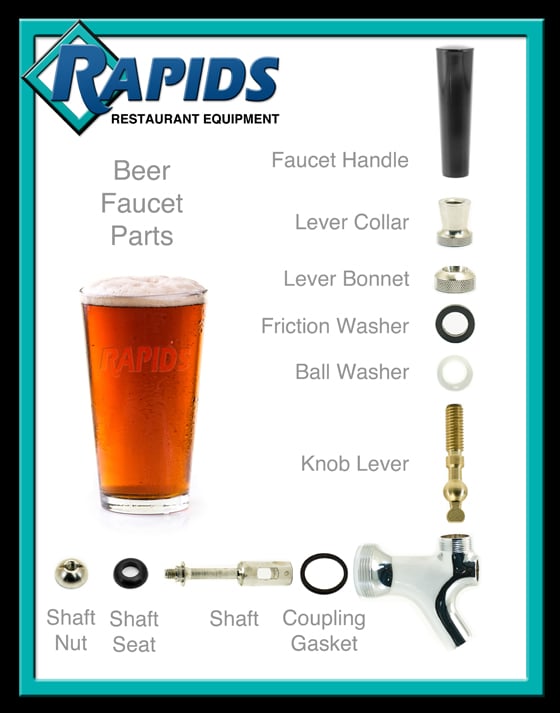
Faucet Parts Diagram

Attaching the Beer Line

Attaching Beer Line to Shank
To the beer shank on the inside of the door, you will attach the beer line. Be sure to place the washer inside the hex nut end of the beer line before you do this. Failure to do so will likely result in a leak of both beer and CO2. Snug it up with a wrench.

The opposite end of the beer line will attach to your keg coupler. The keg coupler is the piece that you use to actually tap the keg. Again, make sure you put a washer between this connection and snug it up with a wrench. It is possible the beer line will be longer than what you need to connect the beer faucet to your keg, but DO NOT cut or alter the line. This particular length has been factored in the regulator set up that comes up a little later.
Beer Line to Coupler

Installing the Drip Tray (optional)

Optional Drip Tray

If your kit came with a drip tray, now would be an opportune time to install it before you put your drill away. Start by locating a distance about 12 inches below your beer faucet. 12 inches should be sufficient for resting a taller flute style beer glass. If you grab the drip tray holder and a bubble level, you can make a couple of marks on the door where the holes are on the holder for the screws. Save yourself frustration by punching a divot with your hammer and awl on those marks. With a smaller bit, drill through the metal exterior of your door. Grab the holder and the pair of sheet metal screws and secure it firmly to the door with a screwdriver.

The plastic drip tray fits on top of the holder and the grid platform goes right on the top of the tray. The drip tray is perfect for resting any glass of beer while or after pouring, but I would caution you, I have not attempted to rest a full sized solid glass pitcher full of beer on it, that might be a little too much. My smaller plastic pitcher did just fine. If you need the capability of holding a big glass pitcher, you might want to look at some of the more robust commercial drip trays, or reinforce this one by running longer bolts with washers and fasteners on the inside of the door.

Attaching the CO2 Line

Attaching CO2 Line
Okay, now that the beer line is ready to go, we turn our attention towards pressurization. First, grab a hose clamp and put it over one end of the red CO2 line. Then slide the CO2 line over the gas nipple on the keg coupler. If the CO2 line is really hard and you can’t get it to slide up, you can soak the end in warm water for moment to loosen it up a bit. Once you get it all the way up on the nipple, slide the hose clamp over the CO2 line around the nipple and tighten firmly with a screwdriver.

Attaching CO2 Line
Next, grab another hose clamp and pop it over the opposite end of the CO2 line. Slide that end over the gas nipple that you find sticking out of the bottom of the CO2 regulator. Once you have it slid all the way up the nipple, position the hose clamp over the CO2 line around the nipple and tighten that one firmly with your screwdriver. It’s important that the hose is all the way up the gas nipples and clamps are very secure to prevent gas leaks.


Filling Your CO2 Cylinder and Attaching the CO2 Regulator

If you haven’t done so yet, have the CO2 tank filled by a professional. Due to shipping restrictions, they cannot be transported with anything in them. You can check with your local beer distributors on places they would recommend having your tank filled, or look for outfits in your area that service fire extinguishers. In Eastern Iowa, HawkeyeFire & Safety would be happy to help. They can supply you with not only CO2, but Nitrogen and blended gasses, and they can check and repair your regulator should it take a fall or grow tired over time.

Hawkeye Fire & Safety Website
Welding supply stores can often fill or exchange your tank. When you exchange, you will likely receive a cylinder with a pretty rough exterior back, but you can rest assured it has been recently inspected. Hobby stores that supply to paintball enthusiasts may be another option in your area.

Okay, now that the cylinder if full, attaching the regulator is pretty straight forward. With the cylinder valve closed and the valve on the regulator closed, thread the coupling hex nut on the regulator on the cylinder. Tighten firmly with a wrench.

Attaching CO2 Regulator


Tapping the Keg

Attaching Coupler
Now we’re talking! Place the CO2 tank with the attached regulator in the back corner of your fridge. Make sure you will be able to reach it to work the valves and adjust the pressure on the regulator. Next, place the keg inside your refrigerator. In a perfect world, you would give the keg time to “settle” or “rest” before tapping. The contents are likely agitated from travel. Admit it; the ride home from the store in the back of your pickup is less than ideal. And did the keg hit every step on the way down to the basement? A 24 hour break in the cold refrigerator is ideal, but I know you’re likely thirsty by this point. Just keep in mind that the beer will flow better after the keg has had time to rest. It’s a lot like shaking up a can; expect a lot of head and foam at first. My advice, go grab a sixer and wait until tomorrow. But to each his own I guess.

Take the keg coupler and mount it to the keg. Do this by inserting the coupler into the locking neck of the keg and rotating the coupler clockwise. It’s best to hold the coupler by the metal parts at the bottom when doing this. Once it’s mounted, engage the coupler’s probe by either rotating the wing handle clockwise (wing style coupler) or pull the handle out and push down until it locks (lever handle style coupler).

Pressurizing the System
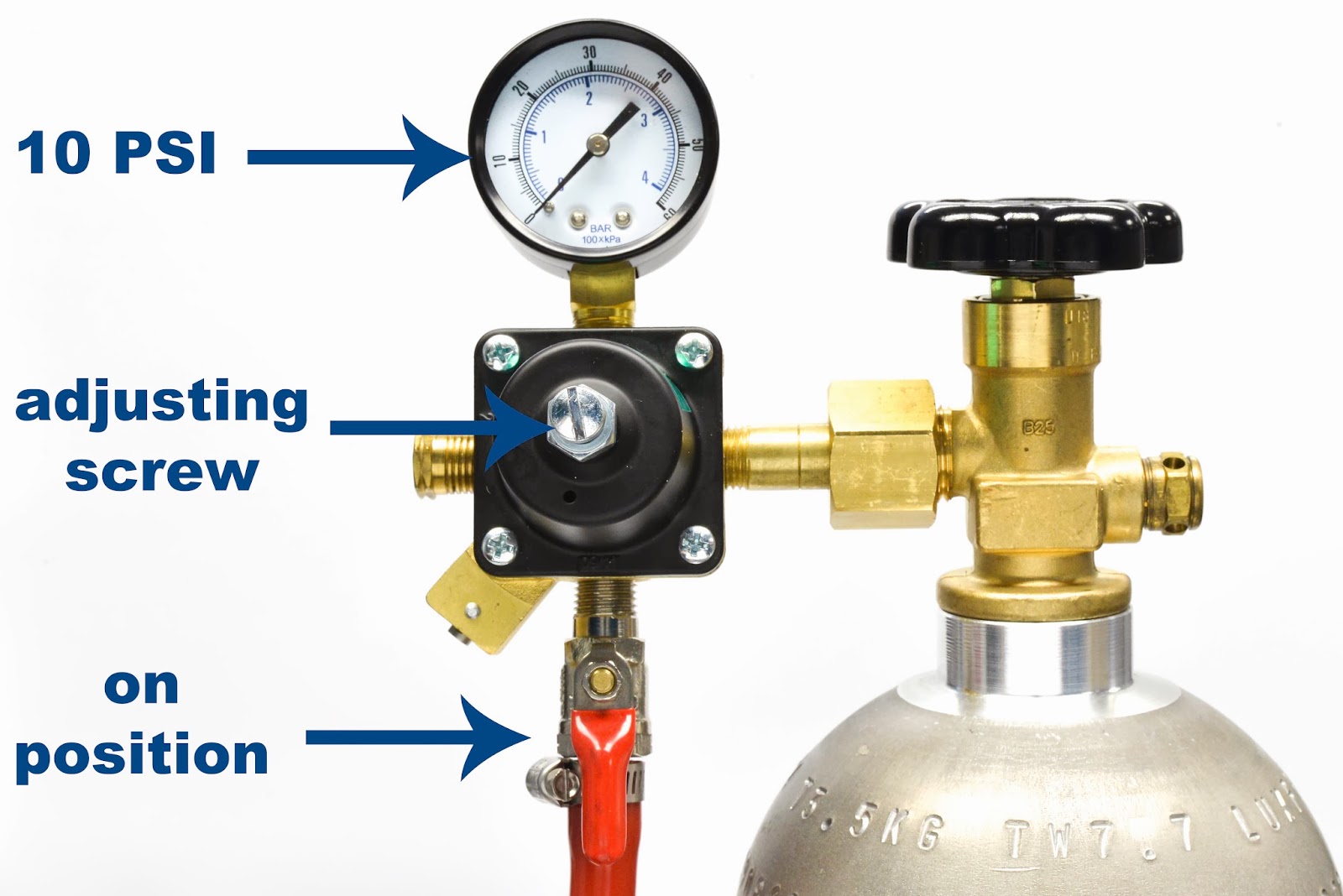
The last step (apart from drinking beer) is to pressurize the system with the CO2. Do this by opening the CO2 cylinder valve by rotating clockwise all the way. Then open the valve on the CO2 regulator. This will be “in line” with the CO2 hose. Next you will fine tune the amount of pressure in the keg by tweaking the adjustment knob/screw on the regulator itself. Start out at about 10-12 PSI for most domestic ales and lagers. Rotating the knob/screw clockwise will increase the PSI and rotating the knob/screw counter-clockwise will decrease the pressure. When you decrease the pressure, however, you will need to release it from the keg too. This will happen over time as you dispense beer, or you can pull the relief valve for on the keg coupler for a quick second to vent it.

Spot It Leak Detector
Check the system for gas leaks. The best way is to use this Spot It Leak Detector. Apply this stuff to the system and it will produce a large fluorescent bubble at the spot of a leak. If you would rather save the meager eight bucks, at least spray some soapy water around the attachments and look for bubbles.

Pouring Beer

Finding the “sweet spot” for the perfect pour is an art all into itself. Variables like beer temperature, cabinet temperature, beer type, altitude, beer line length, beer line cleanliness, faucet cleanliness, resting state of the keg, type of glass, temperature of glass, and more all play a role. Check with your beer distributor for the ideal pressure and temperature. Most beers should be kept at around 35°F.

When you pour, make sure you are using a clean glass. You want to hold it at an angle at the proper distance. Too close, you may not get enough head. Too far, and you may get too much head. It takes a little trial and error, but soon you’ll get there. The best tip I have to help you get closer to proper pour enlightenment with a balanced beer dispenser system is to open the faucet fully and quickly. Some folks mistakenly think you can regulate the head by partially opening or slowly opening the faucet. No way, that’s not how it works folks. Always open the faucet fully and quickly. I might let the first millisecond of the flow fall into the drip tray and then insert my glass into the flow depending on the beer type, but I always use a quick draw.

Good to the Last Drop

Kegerator Cleaning Kit
It is essential that you maintain a clean and properly pressurized system to ensure the right taste and appearance pint after pint. The entire beer system should be thoroughly cleaned after each keg or once a month at the very least. The faucet should be cleaned with a faucet brush regularly. Personally, I use this combination faucet plug/brush that cleans the faucet every time I go to pour a beer, that way I don't half to think about it. Wild foamy beer and sour taste is often caused by yeast build-up in the faucet. Clean your beer dispenser with a reputable Beer Line Cleaner (BLC) solution as often as convenient. Rapids builds this kegerator cleaning kit to make this process fast and painless. See it in action on Rapids YouTube Channel in this tutorial that shows you how to use the kegerator cleaning kit.

The CO2 system should be “on” as long as there is beer in the keg. Shut it off when the keg is empty. Replace anything on the system that looks worn out, especially note the condition of o-rings, gaskets, and seals. Rapids carries all the replacement parts needed. You can find them at www.rapidswholesale.com.

Maintain a constant internal temperature. Monitor the cabinet temperature with a thermometer. The most accurate reading would be from a probe thermometer placed in a glass of water inside the refrigerator. This will tell you the likely temperature of the liquid beer inside the keg. Air temperature can vary depending on how the refrigerator circulates the air and where you place the thermometer. I put my thermometer in a glass of water right on top of the keg. 33°F for me, I like cold beer.

And remember, if you have any questions about the Rapids Home Refrigerator Kegerator Conversion Kits, feel free to buzz the Beer Experts at 1-800-472-7431 or jump on their online chat.


Cheers,
Paul

Thursday, October 3, 2013

Rapids Restaurant Equipment Expanding Retail to the Twin Cities

Rapids Restaurant Equipment - St. Paul, MN


Rapids Wholesale to Open Cash & Carry Store in The Twin Cities

ST. PAUL, Minnesota (Oct. 2, 2013) -- Rapids Wholesale is proud to announce plans to open a new cash and carry retail store in St. Paul. The 19,000 square foot retail space will carry everything you need for your restaurant, bar, civic organization, church, school, home gourmet kitchen, employee dining facility and more . . . anywhere high quality foodservice, bar equipment and supplies is needed or desired. 

"We have listened to our customers and plan to have plenty of what you need, when you need it -- on hand and ready for immediate use in your facility!" - Joe Schmitt, Co-Owner

The new location will be located conveniently off of highway 280 and Como Ave (next to Appliance Smart). There will be a friendly and knowledgeable group of associates willing and able to assist you with all of your restaurant equipment, bar equipment and supply needs.

Harold Parten has been appointed to be the General Manager of the new facility. Parten comes to us from an extensive retail and wholesale distribution background including the Target Corporation. The store will operate with a staff of 4-6 sales associates and the St. Paul contract and design team will be relocating to the new facility as well. There will be several thousands of items in stock for sale at the new store location.
"I am excited to be a part of the Rapids family and look forward to meeting the talented chefs and foodservice people in the Twin Cities." - Harold Parten, General Manager

The New Rapids Restaurant Store Will Be Located Here

2475 Doswell Ave
St. Paul, MN 55108


View Larger Map

Thursday, July 11, 2013

Two-in-One Technology Meets the Modern Commercial Kitchen │ Hobart Combi Ovens

Hobart Combi Oven at Rapids Wholesale
Hobart Combi Ovens at Rapids Wholesale

Technology constantly advances as we find ways to combine our gadgets. Those who stay on the cutting-edge carry their phones, high-resolution cameras, high-speed internet, music, and videos all in a single, pocket-size device. This works when it comes to entertainment — so why not apply the same concept to your kitchen? Combining technologies is a great way to save time and money while enhancing the quality of your products.  And adding a Hobart combi oven from Rapids Wholesale is a great place to start.

Commercial combi ovens combine the mechanics of a convection oven and a steamer, allowing users to benefit from both cooking methods in a single dish. Luke Green, a Rapids Contract and Design specialist familiar with Hobart combi ovens — he’s used one to cook mac-and-cheese, twice-baked potatoes, chicken on the bone and other yummy dishes from scratch in Rapids’ own test kitchen — sees French fries as a great example of steam/convention oven cooking.  Green described how you can forego a fryer and fatty oils by using steam to create a humid cooking environment. Then, in the last few minutes of cook-time, you switch the oven to convection mode. This crisps your fries on the outside, Green said. Using this technique, you can offer a healthy side dish without sacrificing taste, texture, and appearance.

“It’s how you go about cooking your product in a combi oven that sets them apart from a standard oven,” Green said. “To achieve the same results in a standard oven, you have extra steps and multiple pieces of equipment needed.” 

Check out this Rapids Exclusive video series with Hobart's "Combi Guy" David Sager, CFSP and Combi Oven Product Line Manager - Hobart Corporation


Rapids can set you up with either a full-size or half-size Hobart combi oven, with 6, 10, or 20 levels. In addition to setting the temperature on these ovens, you can also customize the level of moisture in all 5 models by adjusting the humidity at percentage points between 0% and 100%. On top of that, you can change the airflow in the cabinet by setting the speed of the combi oven’s fan. This comes in handy for delicate recipes, like meringue pies and pastries. Technology like this gives you greater control over a wide variety of recipes.

These models even let you program up to 100 recipes at time. And, as Green explained, Hobart’s combi oven design is the only one with a bar code scanner that works in conjunction with recipe-programming. After setting the recipe for a particular product, you just scan its barcode, and the oven will remember how to prepare the product. Hobart combi ovens are self-cleaning, as well, which will definitely save time in your kitchen!

Almost all food service establishments stand to benefit from using a combi oven. Green said catering businesses, educational institutions, and upscale restaurants might feel the need most. Any venue that calls for hassle-free, consistent bulk-cooking will likely see a big difference after installing a commercial combi oven.

Green said although adding a Hobart steam/convection oven won’t eliminate your need for other cooking equipment, Rapids can provide you with a quote to help meet your needs efficiently. Green and others on the Rapids contract team can assist you in determining which equipment to have on hand with your commercial combi oven, and which items you can skip. Contractors can also go over the possible energy-savings benefits of choosing a combi oven. To modernize your kitchen, get in touch with a Rapids contractor or sales rep, give us a call at 1-800-472-7431!

Written by Holly Hines

Friday, June 28, 2013

Perfect Product Fast, No Hoods or Microwaves Necessary: Ovention Matchbox Countertop Oven


Pepperoni pizza. Paninis. Chocolate chip cookies, chicken, cheesy bread, and chewy brownies. People love baked favorites like these. Now, imagine serving them at lightning-fast speeds, without using microwaves. With the Ovention Matchbox countertop oven, now you can! Here at the Marion location of Rapids Wholesale, we saw the evidence with our own eyes — on a bus, no less, where Ovention Sales Rep Aaron Ulmer and Midwest Professional Rep Chris Merritt offered product knowledge, and prepared us a fast, mobile feast.

As Merritt and Ulmer demonstrated, the Ovention Matchbox can be used as a portable convection oven, a conveyor pizza oven, or an outdoor oven for mobile carts — making it one of the best and most versatile countertop ovens. It stands at just below 21 inches tall and 62 inches wide, with a depth of 35 inches. And the technology built into this convenient, mini oven gives it some unique powers.

For starters, the Ovention Matchbox is safe for ventless operation. That’s right — no hood required. This is true thanks its catalytic filtration system, the same technology used to filter emissions from cars. The filtration limits the Matchbox’s output of smoke, grease, and other vapors. It can’t handle fatty raw proteins, like bacon, but it’s good to go for most anything else! 

This includes offering a high-variety, quick-service menu without sacrificing quality. The cabinet design of the Ovention Matchbox, another of its highly unique features, makes this possible. The Matchbox comes with two self-loading compartments that shuffle into and out of the heated chamber on their own. While your product is baking, this chamber stays shut. No energy or heat can escape, unlike a conveyor oven. The result? Lower energy bills, and a 3-minute bake-time for pizzas.

Check out this video of the Matchbox Oven in Action from Rapids' YouTube Channel!


More on the Ovention Matchbox Commercial Oven

Inside the Ovention Matchbox’s chamber, a variety of products can bake one after the next. You program your own recipes based on variables including temperature, timing, and upper and lower air velocity. Adjustable velocity is key, as this is what allows Ovention Matchbox to produce perfect crispy-crust pizza at one moment, then chewy deep dish the next.

And there’s almost no wait to change temperatures for different products. This sets the Matchbox in a class above most countertop pizza ovens and portable convection ovens.

The Ovention Matchbox is also ridiculously easy to operate. Once you preset up to 1,000 recipes, a touch screen on the front allows users queue up the perfect formula for each product at the touch of a button. It can also display the wait time for customers.

As Midwest Professional Rep Chris Merritt emphasized, the Ovention can work wonders in a multitude of venues. It’s an obvious choice for mobile carts and convenience stores. But it’s also great for businesses or institutions providing a limited late-night menu after shutting down the kitchen. 

If your business could benefit from the Ovention Matchbox’s many talents, or if you’re looking for more information on this countertop oven’s capabilities, don’t hesitate to give us a call at 1-800-472-7431 or jump on Rapids Online Chat! One of our sales reps will be happy to go over specs, shipping, pricing, and anything else you may need to know.

Written by Holly Hines

Wednesday, June 26, 2013

The “Eyeballing Method” Vs. The Portion Scale: Why Food Portion Control is Key

Edlund Scales at Rapids Wholesale
Portion Scales at RapidsWholesale.com
If you’d like to save money and improve your menu simultaneously, you may want to take advantage of our current sale on an inexpensive tool to help with both goals: a portion scale. You may be thinking: why should I spend on portion control tools? My staff can eyeball the correct portions, right?

Unfortunately, that may not be the case. Using an “eyeballing system” could end up costing you. Inexact portioning can lead to several negative consequences, including over-use of costly ingredients, funny-tasting food, food with an unappealing appearance, and a growing number of unsatisfied customers. An Edlund scale may be the best way to avoid these issues. Allow me to illustrate.

Basic Kitchen Arithmetic and Portion Control Scales

Let’s start with a little math. As an example, say you own a deli, and your deli serves 100 turkey sandwiches a day. A typically-portioned turkey sandwich needs roughly 2 ounces of turkey. But, let’s say your kitchen has no portion scale, and the staff isn’t great at eyeballing. They may ere on the heavy side when it comes to turkey; let’s say an extra ounce per sandwich. If half your total sandwiches are made with 3 instead of 2 ounces, you spend on 50 unnecessary ounces of turkey a day. In a week? About 22 pounds. And in a month? That’s almost 100 lbs. of turkey. Never-mind the ham, roast beef, cheese, and other products you serve. These numbers are just examples, but you get the picture. Small amounts add up.

Now you may be thinking: I don’t want to skimp on serving sizes for my customers, either. And this is true. However, to provide a perfect sandwich, you need perfectly-portioned ingredients. The ratio of cheddar to ham or provolone to roast beef can make a difference. Once you find the right balance taste-wise and budget-wise, make sure your staff has the tools to stick to it.

Likewise, looks make a difference to the typical customer’s eye. If your meat portions look small compared to the bread you’re using, customers may go into the meal assuming it won’t fill them up. And if the portions really are too small, they’ll definitely leave hungry. After ordering a sandwich that’s thin in the middle, a first-time customer may not return, no matter how great the taste. Food portion control and an Edlund scale can help you create balanced-looking dishes to please customers’ eyes and stomachs.
The flip-side of that coin is that some people seek to avoid over-filling. Healthy diets are trendy, and portion control is a big part of any diet. Many restaurants offer particular menu items portioned to fit into customers’ healthy lifestyles. Customers counting calories and watching what they eat have their eyes peeled for portion sizes. Make sure the healthy section of your menu won’t disappoint them.

Food portion control is an easy way to keep all the above-mentioned customers appeased. It enhances both taste and presentation, and equips staff to produce quality products quickly and confidently. And, right now, Rapids is making the choice even more obvious by offering a great sale on select Edlund scales while supplies last! To take advantage of this deal, check out Rapids E-Newsletter Deals, and be sure to sign up for it on rapidswholesale.com to receive these offers first, or a call a Rapids rep at 1-800-472-7431!


Written by Holly Hines

Monday, June 10, 2013

Star Light, Star Bright: Star Panini Grills, Star Roller Grills, and Stainless Steel Griddles at RapidsWholesale.com

Star Commercial Kitchen Equipment at RapidsWholesale.com
Star Commercial Kitchen Equipment

A recent presentation left Rapids Wholesale reps “Starry-eyed” — particularly when it comes to commercial Panini grills, hot dog roller grills, and commercial charbroilers and griddles. Lorne G. Deacon, regional sales manager of Star Manufacturing , paid Rapids reps in Marion a visit this month to shed light on some high-demand equipment for restaurants, sandwich shops, convenience stores, and other businesses.
Deacon’s spotlight fell on some new features of Star’s Ultra-Max line, which includes heavy duty griddles, charbroilers, hot plates, and other related restaurant-grade equipment. In addition, Deacon delved into hotdog and sandwich grilling options. To learn more, take a peek at the videos and information below — and, as always, give us a call at 1-800-472-7431 if you still have questions!

Ultra-Max: Commercial Charbroilers, Griddles, and Hot Plates

Star has added some updates to its Ultra-Max line — including the twinkle of added stainless steel griddle components. Deacon said they’ve done away with thermal plastic knobs , replacing them out with stainless steel ones. Star has also upgraded the warranty on Ultra-Max units like this 36" gas griddle or this 36" commercial charbroiler to three years!
Ultra-Max griddles — among the best griddles you’ll find — come with a 1” thick chrome plate that holds heat, decreases energy expenses, and reduces clean-up time. The charbroilers come with adjustable grates and steel drip deflectors that steer grease away from the water pan. Star also does hot plates, like this gas unit. These units boast a flat top, making it easier to move pans from one burner to the next. As Deacon said, “we have an offering in every single countertop space, we feel.” 

Ultra-Max Product Spotlight Video


Star-Max and Ultra-Max Technology Upgrades Detailed Video


Star Hot Dog Roller Grills

Summer, the season of hot dogs, is on the horizon. Customers can load them with chili, or squirt on some ketchup. They can enjoy them on-the-go, at a carnival, or outside at the park under the June sky — but first, you’ve got to grill them.
Star roller grills are designed to show off your product. Built with a slight slant, hot dogs and brats roll in easy view, tempting passers-by. Rapids carries models with both standard non-stick and Duratec advanced non-stick rollers. Our roller grill lineup includes models for 35 or 40 dogs, with an optional a bun warmer.

Star Rollergrill Products Spotlight


Pro-Max Commercial Panini Grills and Sandwich Grills

Who wants a cold sandwich when they could have a warm, toasty one? One-by-one, sandwich shops and other restaurants are catching on to the allure of melt-y, cheesy heated sandwiches. If you’re looking to get on board with this trend, or to increase your production of these popular offerings, a Star sandwich or Panini grill may be your best bet.
For flexibility when it comes to sandwich and Panini grill recipes, you may want to try the Grill Express. This versatile grill can handle a skinny quesadilla, a packed 3” sandwich , and most anything in-between. It comes equipped with two cast iron plates, offering excellent heat distribution.
If you’re focusing on Paninis, we offer both cast iron and aluminum ribbed Star models. These come with a removable grease drawer, and an accurate thermostat rated between 175° and 450°F.


Star Panini Grills Product Spotlight Video


To order any of these units, check out the Rapids Wholesale website, or call a rep at 1-800-472-7431!

Written by Holly Hines.

Wednesday, June 5, 2013

Rapids Wholesale Helps Customers Understand Energy Efficiency and Savings


Energy Effecient and "Green" Commercial Kitchen Design

Rapids Wholesale Contractors are working daily to find energy-efficient, cost-effective design solutions to share with business owners. Contractors and Rapids sales reps accomplish this in part by working with manufacturers who also use “green” solutions, like Vollrath. Recently, Vollrath’s director of consultant sales, Suzanne Painter-Supplee, visited the Marion branch of Rapids Wholesale to discuss energy-savings strategies with Rapids associates.

The contract team at Rapids uses energy-savings strategies to help customers become certified in the Leadership in Energy and Environmental Design Program, otherwise known as LEED, a U.S. Green Building Council initiative. Businesses with LEED certified designs can save on expenses, build environmental awareness, and qualify for tax credits.

“We look at the customers’ needs and help educate them along the way,” Hodnefield said.
Christie Hodnefield, a certified contract interior designer at Rapids, is familiar with LEED and energy-efficient equipment. According to Hodnefield, it’s crucial to pit low up-front cost against potential energy-savings, especially when it comes to large items like refrigerators and ovens. Choices that seem inexpensive may end up costing extra money on energy bills in the long run, said Hodnefield. Rapids contractors are available to help customers find the most cost-effective choice when it comes to decisions like this.


Right now, Rapids contractors are helping an Army National Guard Readiness Center receive a “silver” LEED certification level, the second rung on four-rung energy-savings ladder. So far, contractors have helped the center find an efficient convection oven, cost-saving exhaust hoods, dishwashers that reduce water use, and other equipment with similar energy-related benefits. Painter-Supplee, Vollrath’s director of consultant sales, is also knowledgeable when it comes to “green” solutions. She discussed this topic in an interview with Rapids videographer Paul Adams. During the interview, she highlighted induction cooking, disposables, and the use of aluminum composite material.

Painter-Supplee described a Vollrath beverage lid dispenser as an example. She said customers tend to pick through stacks of lids out in public, seeking one no one has touched —leading to waste. Vollrath’s design eliminates this problem by dispensing only one lid at a time, Painter-Supplee said. She also praised the use of aluminum composite material. This architectural component is a bendy combination of aluminum and polyethylene. Painter-Supplee emphasized its aesthetic advantages, explaining how easy it is to sculpt into seamless, curvy shapes. Choosing aluminum composite material may contribute to reductions in unsafe emissions, too, because it’s lightweight. This means it requires less fuel to transport and produce.

Interview with Suzanne Painter-Supplee on LEED  Initiatives in the Foodservice Industry


Both Hodnefield and Painter-Supplee view the use of induction heat as a good strategy for reducing energy waste. Induction equipment focuses heat on the surface directly below pots and pans, and nowhere else, allowing little warmth to escape. Hodnefield also said this strategy can lead to ventilation-related savings and speed up cook-times.

Rapids Wholesale contractors and sales reps encourage customers to call Rapids with questions on how well-selected equipment can lead to money savings and good environmental practice. Associates are available at 1-800-472-7431, Monday through Saturday.

Written by Holly Hines

Ovention® Matchbox® Demonstration Event Scheduled at Rapids Wholesale!


Ovention Bus is Parkin' at Rapids!

Come join Rapids Wholesale for a FREE LIVE Demonstration of the 2013 Kitchen Innovations Award winning new oven design by Ovention  the Matchbox Oven! Ovention, inventor of the popular TurboChef® oven, revealed this revolutionary new design at the North American Association of Food Equipment Manufacturers (NAFEM) show in Orlando, and the National Restaurant Association show in Chicago. It was a pretty big hit with chefs, restaurant owners, and dealers at the shows. We wanted to see more and invite you to join us. Ovention was happy to oblige and is coming to treat us with a tasty demonstration.

The Matchbox® Oven


The Matchbox oven is kind of like a conveyor oven, but with some very distinct improvements. Unlike a traditional conveyor oven, the unique "End Cap" system minimizes hot air escaping from the cavity of the oven greatly reducing energy consumption. Doors open only when food is going in or coming out of the oven. No hood is required to operate, and with its small footprint, you can install it almost anywhere. The Matchbox oven has an intuitive touch screen display with which you can pre-program up to 1000 different cooking settings to bake, broil, grill and roast your favorite dishes. 

Check out this Video for a tour of this Revolutionary New Oven Technology


Rapids Wholesale Live Public Demonstration Details


We will be hosting the Ovention bus and crew under the sun at our place. Mobile Kitchen Captain Aaron Ulmer along with Chris Merritt CFSP, ServSafe, MAFSI and Partner/Owner of Midwest Professional Reps will be here to answer any questions you may have. These guys are EXPERTS on all things Ovention, and fine cooks to boot! They'll be preparing samples while demonstrating how the new technology works.

Expect to enjoy:
  • Hot Dogs and Buns
  • Panini Sandwiches
  • Pizzas
  • Cookies and Brownies
  • Broiled Shrimp
  • Roasted Veggies and more

The event will be held in our parking lot at:

Rapids Wholesale
6201 South Gateway Dr
Marion, IA 52302
1-800-472-7431

We expect them to be set up and cooking from 1:00 to 4:00 PM.

Everybody is invited to come check out these amazing machines!

More Data on the Ovention® Ovens


Ovention Ovens at Rapids Wholesale
rapidswholesale.com

Thursday, May 16, 2013

Commercial Kitchen Cleaning Chemicals for Tough Grease Problems and Carbon Buildup

carbon off at rapidswholesale.com
Commercial Kitchen Cleaning Supplies at RapidsWholesale.com

You may already come to Rapids for your restaurant and bar supplies. But what about commercial kitchen and restaurant cleaning supplies? Turns out, Rapids has that covered too!

When it comes to built-up grease and residue on bake-ware, pots and pans, stainless steel, fryers, and more, our sales reps have several solutions to offer. Take a look at some of our featured options:

Carbon-Off! Aerosol and Liquid Gel


Baked-on carbon that sticks to pans, muffin tins, Panini presses and other items can cost businesses. It can result in premature replacement of equipment, misspent labor, and inconsistently-prepared products.  Carbon-Off! available in both an aerosol can for regular maintenance, and a gel solution for tougher jobs makes carbon removal surprisingly simple, according to Patty Russell, National Sales Manager at Discovery Products, the company that makes Carbon-Off!

Carbon-Off! contains a thick, waxy paraffin that easily picks up residue. Russell demonstrated how it combats carbon for Rapids sales reps at the Marion, Iowa location this week.

Russell advises users to apply Carbon-Off! and then leave it to cool and dry. After only an hour, its job is done. At this point, users can literally peel or brush it away from the surface of pots and pans, taking layers of carbon with it.

See it action, check out this video . . .


Fryer Puck


During her visit, Russell described a tale of wasted labor that may be familiar to business owners serving fried food. It goes like this:

The fryer where profit-boosting French fries and other snacks are cooked needs cleaning. So, you send an employee away from the storefront, prep, or cooking duties to start the cleaning process and to babysit the machine in case the cleaner boils over.
Perhaps the employee gets bored, or distracted, or tired. For whatever reason, his attention drifts. The cleaning solution in the fryer comes bubbling to the top and spills over the edge. It’s back to step one. Meanwhile, you’re one employee down.

The solution? Take advantage of Fryer Puck’s low-foaming formula. It keeps the cleaner from boiling over, works on a variety of fryer types, and spares you wasted labor and a mess.


Russell explains how is works in this video . . .


Brite Shine


If stainless steel equipment in your kitchen is visible to customers, it’s on display and subject to customers’ scrutiny. To keep your reputation squeaky clean, you need to keep your equipment clean, too.

For jobs like this, we offer Brite Shine, a product that strips away grease and allows users to buff surfaces until they gleam. The website for Brite Shine states the cleaners contains only “food grade or other high quality” ingredients.
During a demo, Russell showed sales reps the results of wiping down the commercial refrigerator in our test kitchen with Brite Shine. Though its surface hardly looked dirty to start with, once all fingerprints and traces of grease were gone, the difference was obvious. Now, imagine this effect applied to all your greasy machines!

Live demo in our test kitchen in this video . . .


Foam Plus


Try Foam Plus to clean your ovens and even griddle tops. It can be used while the equipment is still warm!  Simply heat the dirty oven to 200°, spray your Foam Plus, wait a whopping 15-30 seconds and wipe off.  Rinse with a vinegar rinse. Done!

Patty explains how to apply in this video . . .


If you think any of these products might save you time, labor, or hassle, don’t hesitate to give us a call! Rapids sales reps are available to answer questions or place orders Monday through Saturday at 1-800-472-7431 or, you can place your order online at rapidswholesale.com!


Written by Holly Hines